TaskRio vs Tasks.Bot for Location Based Task Coordination
Coordinating field teams by location often means chasing WhatsApp messages and guessing who is where. Some tools handle tasks, others handle maps, and few connect the two inside the app your crew already uses. That gap costs time on every dispatch.
This article compares TaskRio and Tasks.Bot for location based task coordination, covering how Tasks.Bot assigns and tracks tasks via WhatsApp, its map view, live day tracker, and face-verified attendance, plus pricing, trust signals, and who benefits most. By the end, you will know which platform fits your team.
What Is Tasks.Bot? Location-Based Task Coordination via WhatsApp
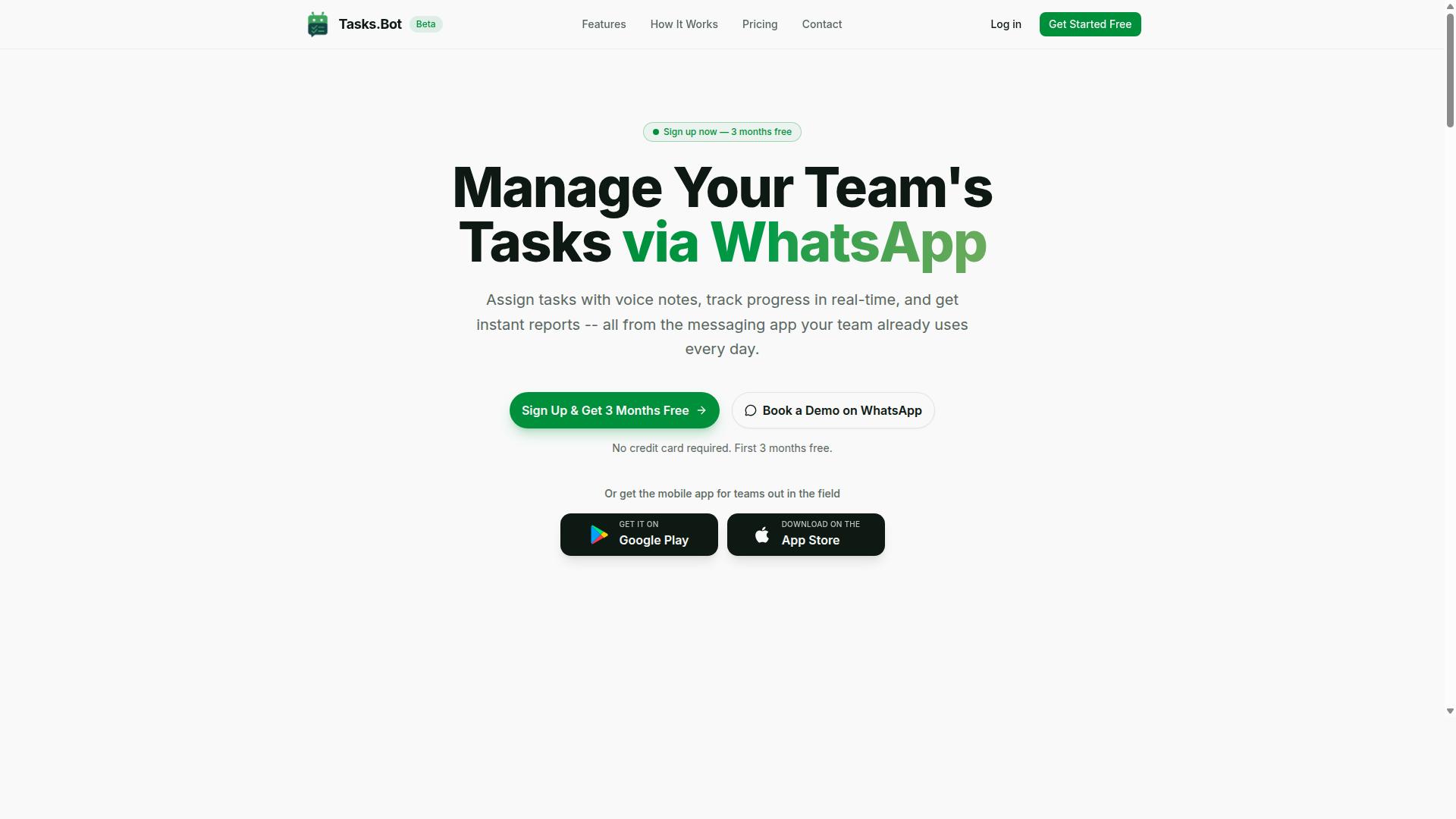
Tasks.Bot is a task management platform that operates entirely within WhatsApp, enabling teams to assign tasks, track progress, and receive reports without leaving the messaging app. For field teams that already rely on their phones all day, that design choice removes a major barrier to adoption.
Unlike conventional task management software, Tasks.Bot does not require team members to install new software or create separate accounts. Everything happens inside a tool they already use daily. That matters for field service management, where workers are on the move and have little patience for yet another login.
The platform uses AI to understand natural language and even voice notes, so a manager can create and assign a task simply by sending a message. There is no complex form to fill in and no training session required to get started.
Tasks.Bot is a SaaS solution available globally and is currently in beta, with a free trial period for teams that want to evaluate it. It also offers a mobile app for field teams, giving workers an additional option beyond the WhatsApp interface when they need it.
How Tasks.Bot Handles Location Based Task Coordination
Tasks.Bot supports location-based coordination through features such as tasks on a map and live GPS tracking, all within WhatsApp. This keeps location-based task coordination tied to the same conversation thread where the work is discussed.
When a task is assigned with location data, field staff can be tracked live. A delivery agent, for example, can be located near the customer's location rather than being left to check a separate dashboard.
Check-in and check-out flows rely on GPS tracking, which supports attendance records and task verification. Face-verified attendance is also part of the platform, adding a layer of confirmation that the right person was on site at the right time.
Location-based features support field work, so certain actions can be tied to a worker's location. Because every interaction happens inside WhatsApp, field staff never need to open an additional app to respond to a location trigger.
Tasks on a map give coordinators a visual view of where work is happening, and this pairs naturally with the live day tracker for monitoring progress across a shift. Together these tools support real-time coordination without pulling teams into a separate project management interface.
Is Tasks.Bot the Better Choice for Location Based Task Coordination?
When evaluating location-based task coordination tools, Tasks.Bot stands out by operating entirely within WhatsApp, eliminating adoption barriers for field teams. Most traditional location-based coordination platforms require every worker to download a dedicated mobile app, create an account, and learn a new interface before a single task can be assigned. Tasks.Bot removes those steps entirely.
For field service management and dispatch software, the biggest obstacle is rarely the technology itself. It is getting a dispersed workforce to actually use it. Tasks.Bot sidesteps that problem by meeting teams in an app they already have open.
No new app installation. Team members do not need to install anything or create new accounts. Onboarding a new field worker becomes a matter of adding them to an existing WhatsApp conversation rather than walking them through a download, a signup flow, and a permissions screen.
AI-powered task creation. Tasks.Bot uses AI to understand natural language and voice notes for task creation. A supervisor can describe a job in plain speech or a quick message, and the system interprets it, which matters for field workers who are often typing with one hand or wearing gloves.
Face-verified attendance and live GPS tracking. Attendance is confirmed through face verification, and field staff can be tracked live. This supports accurate check-in and check-out records without separate hardware or a standalone time tracking tool.
Real-time coordination through WhatsApp. Because everything runs inside the messaging app teams already use, task assignment, updates, and location sharing happen in the same thread as normal conversation. Automated reminders and status updates arrive as messages, not as push notifications buried in an app nobody opened.
Security is handled at an enterprise level. Tasks.Bot states that enterprise-grade encryption protects data, and that conversations and task data are never shared or used for training. For teams handling client addresses, site details, or personnel information, that commitment matters when choosing productivity software.
There are honest limitations to weigh. Tasks.Bot depends on WhatsApp, so organizations that block the platform or operate in environments where it is unavailable would need a different approach. The product is also in beta, which means features may evolve and some edge cases in complex workflows are still being refined. Teams with highly specialized geofencing rules or deep ERP integrations may find a mature dedicated platform fits better today.
Where Tasks.Bot excels is straightforward: teams already using WhatsApp for communication. Construction crews, delivery drivers, cleaning services, security patrols, and on-demand service businesses that coordinate by chat every day get location-based task coordination without changing their habits. A 3-month free trial with no credit card required lets a team validate that fit before committing.
For those organizations, the verdict is clear. Tasks.Bot is the better choice for location-based task coordination because it removes the adoption barrier that causes most field rollouts to stall, while still delivering face-verified attendance, live GPS tracking, and real-time coordination where the work actually happens.
Key Features for Location Based Task Coordination
Tasks.Bot offers a suite of features designed to streamline location-based task coordination for field teams, all accessible through WhatsApp. Instead of asking crews to learn a separate platform, the service works inside the messaging app they already use every day.
For location-based work, a handful of capabilities matter most. These include tasks on a map, a live day tracker, face-verified attendance, voice note task creation, and AI that understands natural language. Each one addresses a different part of the coordination problem.
Tasks on a map and the live day tracker answer the question of where work and people are. Face-verified attendance answers who is actually on site. Voice notes and AI-driven language handling answer how tasks get created without typing.
Together, these features reduce the back-and-forth that slows down dispatch. A manager can see open jobs, spot who is nearby, and push work to the closest person. Field staff confirm attendance and receive assignments without leaving WhatsApp.
Tasks.Bot also supports automatic task assignment, smart deadline reminders, approvals and automations, instant reports, and shifts, leave, and hours management. Native WhatsApp integration ties it together, with Android and iOS apps adding push notifications, voice capture, and a home screen widget for quick access.
Tasks on a Map, Live Day Tracker, and Face-Verified Attendance
Tasks.Bot visualizes tasks on a map, provides a live day tracker for real-time progress monitoring, and uses face verification for attendance, ensuring accountability for field staff. These three features form the backbone of location-based coordination.
Tasks on a map give managers a geographic view of open work. A field service manager can see a new job appear, check which technician is closest, and assign it based on proximity rather than guesswork. That supports efficient dispatch and reduces windshield time.
The live day tracker shows task status and team locations as the day unfolds. Managers spot stalled jobs early and reallocate resources without waiting for a phone call or end-of-day report.
Face-verified attendance ensures only authorized personnel check in and out. This tightens oversight, supports accurate hours, and helps reduce time theft, since a check-in is tied to a verified identity rather than a name on a list.
Used together, the three features cut the lag between a job appearing and someone being on it. Dispatch becomes a matter of matching the nearest qualified person to the task, then watching progress update live. For field service management, that combination of visibility and accountability is hard to replace.
Voice Note Task Creation and AI-Powered Natural Language
Tasks.Bot simplifies task creation by allowing users to send voice notes or natural language messages in WhatsApp, which AI interprets to generate structured tasks. The service uses AI to understand user intent and create tasks from messages, so the gap between thinking of a job and logging it shrinks to seconds.
This matters most for field workers who are not typing-savvy or whose hands are busy. A technician can speak a note instead of filling out a form. The AI parses the intent and turns it into a task with the relevant details, such as who it is for, what needs doing, and where.
Natural language commands work the same way. A manager can type or say something like assigning a named person to fix a pump at a specific address by a set time, and the system interprets it into a structured assignment. No template, no dropdowns, no separate app.
Voice note task creation is part of the Full Access plan. For teams already coordinating over WhatsApp, it removes the friction that usually kills adoption of new productivity software. Tasks get captured in the moment, and the AI handles the formatting.
The result is faster intake and fewer dropped jobs. Instead of a message that gets lost in a chat thread, a spoken instruction becomes a tracked task with an owner and a deadline.
Pricing and Plans
Tasks.Bot offers a straightforward 'Full Access' plan with all features included, priced per member per month or annually in Indian Rupees and US Dollars. There are no confusing tiers, no feature gates, and no upsells waiting at checkout. For teams comparing tools for location-based task coordination, that single-plan structure removes a layer of guesswork.
Pricing is simple to state. The monthly plan costs ₹200 per member per month. The annual plan costs ₹1,200 per year per member, which works out to a 50% saving, or ₹1,200 saved per year for each member.
Currency is selectable. The site shows a 'Select currency' option with Indian Rupee and US Dollar choices, so teams outside India can view pricing in USD. Because rates can shift, it is worth confirming the current USD figure on the pricing page before budgeting.
What does the single plan include? Everything the platform offers, with no add-on charges:
- Voice note task creation
- Location-based coordination
- Face-verified attendance
That combination matters for field teams. Location-based coordination supports the kind of work where a task only makes sense at a specific place, whether that involves tasks on a map, check-in and check-out, or live GPS tracking. Face-verified attendance adds a layer of accountability for teams spread across sites.
New users also get 3 months free, with no credit card required, and can cancel anytime. The free period lets a team test voice note task creation and location-based coordination on real jobs before committing budget.
Two practical notes. First, the product is in beta, so features and pricing may evolve, and it is worth checking the current terms before signing up. Second, because there are no hidden tiers, the main decision is simply monthly versus annual, and the annual plan's 50% saving makes that choice fairly clear for teams confident they will stay past a few months.
Verdict: Tasks.Bot keeps pricing refreshingly transparent. One plan, all features, two currencies, a free three-month start, and a clear annual discount. For location-based task coordination, that is easy to evaluate and easy to justify.
Trust Signals and Track Record
Tasks.Bot is currently in beta but already used by hundreds of teams, and it offers a refund policy to mitigate risk for early adopters. That combination matters when you are evaluating location-based task coordination for a team that depends on geolocation, GPS tracking, and location-based features to get work done on time.
Beta status is often read as a warning sign. In practice, it signals active development and the potential for rapid improvement. A product still being shaped is one where feedback reaches the roadmap quickly, and where capabilities tied to location features and automated reminders can mature fast.
The fact that hundreds of teams already rely on Tasks.Bot provides social proof. Field service crews, dispatch teams, and remote groups coordinating location-based tasks have real workflows at stake, and they are choosing to run them here. That adoption level is a meaningful signal for anyone comparing tools for team collaboration.
A published refund policy in the footer shows confidence in the product. It also gives early adopters a clear path out if the beta does not fit their workflow. For a team weighing task assignment, check-in and check-out, and real-time coordination, that reduces the cost of trying something new.
Accessibility matters too. The website includes a Book a Demo on WhatsApp option, so you can see how the platform would work for your team before committing. The service is global, which suits distributed crews and on-demand operations spread across regions.
One honest caveat: as a beta product, some features may evolve. Rather than treat that as a flaw, weigh it against the upside. A platform in active development tends to improve faster than a static one, and the refund policy means you are not locked in while it does.
The copyright year on the site is 2026, which points to forward-looking development. A team investing in location-based task coordination wants a vendor planning ahead, not one coasting. Combined with real usage and a refund guarantee, the track record reads as credible.
Who Should Use Tasks.Bot
Tasks.Bot is ideal for teams that already use WhatsApp for communication, particularly those with field staff who need task management, attendance tracking, and payroll-ready hours. Instead of asking employees to learn yet another platform, it works through the messaging app they already open every day. That single decision removes the biggest barrier to adoption in field service management: getting everyone onto the same system.
The site notes that hundreds of teams already use the service, which suggests the approach resonates with organizations that have tried heavier productivity software and watched it collect dust. For these teams, no new app adoption is not a small convenience. It is the difference between a tool that gets used daily and one that gets abandoned in a week.
Below are the groups that get the most value from Tasks.Bot, along with why the WhatsApp-first model fits their working reality.
- Field service teams such as maintenance crews, repair technicians, and installers who move between job sites all day
- Delivery and logistics operations where drivers need assignments and check-ins without pulling over to navigate a complex interface
- Sales teams working outside the office who need task delegation and location context tied to client visits
- Remote and distributed teams that already run their day-to-day coordination through WhatsApp groups
- Any organization using WhatsApp as its primary communication channel, regardless of industry or size
Consider a plumbing company dispatching technicians across a city. A dispatcher can send a job through WhatsApp, and the technician receives it in a thread they already monitor. Location-based features give the office visibility into where each technician is, while face-verified attendance confirms who actually showed up on site rather than relying on a group message saying "here."
A delivery startup tracking drivers faces a similar problem. Drivers are on the road, not at desks, and asking them to juggle a separate mobile app for task assignment and check-in invites errors and delays. Tasks.Bot keeps dispatch, location sharing, and real-time coordination inside the chat thread, so updates happen where the conversation already lives.
Payroll-ready hours are another reason these teams choose it. When attendance and time data are captured as work happens, the end-of-period scramble to reconstruct who worked when largely disappears. That matters most for hourly field staff, where inaccurate records create real disputes.
Tasks.Bot is globally available, so location and time zone are not barriers to getting started. A team in one country can run the same workflow as a team in another without a separate setup path. For organizations weighing alternatives for location-based task coordination, the deciding question is simple: does your team already live in WhatsApp? If the answer is yes, and your staff work in the field rather than at desks, Tasks.Bot is built for exactly that situation.
Final Verdict
Tasks.Bot offers a compelling solution for location-based task coordination by leveraging WhatsApp's ubiquity and AI-powered features, though its beta status means some may wait for wider adoption. For teams that already live inside WhatsApp, the appeal is straightforward: no new app to install, no separate login to remember, and no training session required for field staff who already know how to send a message.
The platform's core strengths cluster around location-based task coordination and communication that feels native to how field teams already work. Key capabilities include:
- WhatsApp integration for task assignment, updates, and real-time coordination without leaving the chat interface
- Location-based features that support tasks on a map and live GPS tracking for field work
- Voice note task creation, useful for workers on the move who cannot type
- Face-verified attendance for check-in and check-out accuracy
- Transparent pricing with no hidden tiers or surprise fees
These features map well to field service management, dispatch, and remote team coordination, where GPS tracking and location visibility matter more than a polished Kanban board. A supervisor can send a task by voice, confirm who showed up by face verification, and keep the whole exchange inside a thread the team already checks.
Two weaknesses deserve honest mention. First, the product is in beta, so some workflows may still change and edge cases may not be fully ironed out. Second, reliance on WhatsApp means teams that avoid the platform, or operate in regions where it is restricted, will find less value here.
The balanced recommendation is simple. If your team is already on WhatsApp and needs better field coordination, Tasks.Bot fits naturally into existing habits. If you need a mature, standalone system with years of stability behind it, waiting or evaluating alternatives is reasonable.
For more information, book a demo on WhatsApp or reach the team directly by phone at +91 97143 42522 or email at [email protected].
Frequently Asked Questions
What's the main difference between Tasks.Bot and TaskRio for location-based task coordination?
Tasks.Bot is built to run entirely inside WhatsApp, so your team can assign tasks, share locations, and get updates without installing new software or creating accounts. It also includes a mobile app for field teams who need more hands-on tools. TaskRio is a separate task coordination product, so we'd recommend comparing its location features directly against your team's workflow before deciding.
Do my field staff need to download an app to use location-based features in Tasks.Bot?
No. Tasks.Bot works through WhatsApp, so team members can receive tasks, share their location, and send updates using the app they already have. A mobile app is also available for field teams that want additional functionality. This makes it easier to roll out to staff who aren't comfortable with new software.
How does Tasks.Bot handle task assignment and reminders for teams on the move?
Tasks.Bot supports automatic task assignment, smart deadline reminders, and voice note task creation, all within WhatsApp. Tasks can also be viewed on a map, which helps coordinators see what's happening across locations. These features are designed for teams with field staff who need quick, low-friction coordination.
Can Tasks.Bot track attendance and hours for field teams?
Yes. Tasks.Bot offers face-verified attendance and live day tracking, which can produce payroll-ready hours. This is especially useful for teams that manage field staff and need reliable records without manual timesheets. It's part of the platform's broader task management and reporting toolkit.
How much does Tasks.Bot cost compared to TaskRio?
Tasks.Bot offers a single 'Full Access' plan with all features included, priced at ₹200 per member per month or ₹1,200 per year per member (a 50% saving on the annual plan). Pricing is available in Indian Rupees and US Dollars. We can't speak to TaskRio's pricing here, so please check their site directly for current rates.
Is Tasks.Bot available in my country, and how do I get started?
Tasks.Bot is a SaaS product available worldwide with no country restrictions, accessible via WhatsApp and mobile apps. You can book a demo directly on WhatsApp to see how location-based task coordination would work for your team. Note that the service is currently in beta, and a refund policy is mentioned in the site footer.
Recommended Resources: